Brand identity

Look like the
obvious choice.

Your work is better than your business looks. That gap is quiet, permanent and expensive — it decides who gets asked for a quote and who gets asked for a discount. We close it.

The gap

Nobody is judging
your work.

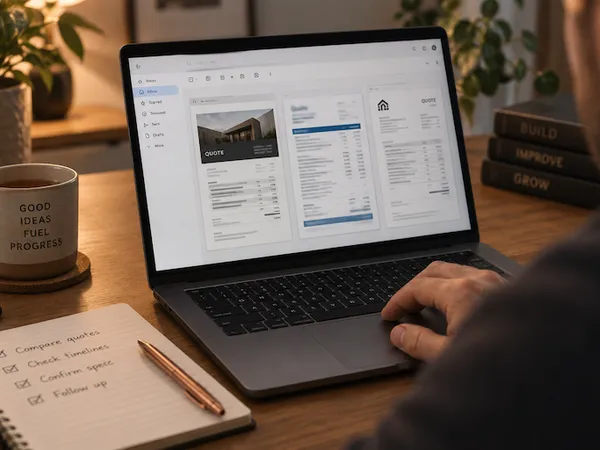
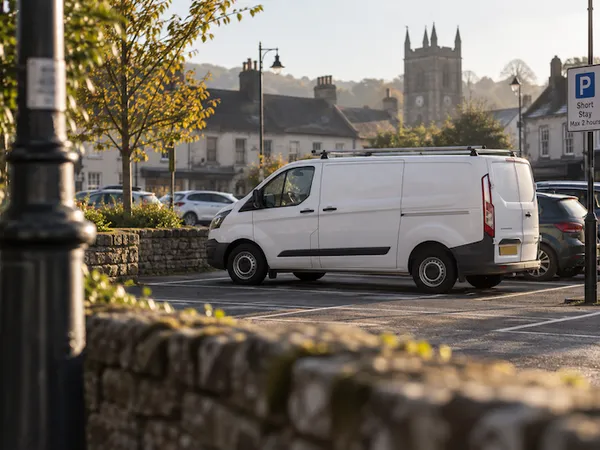
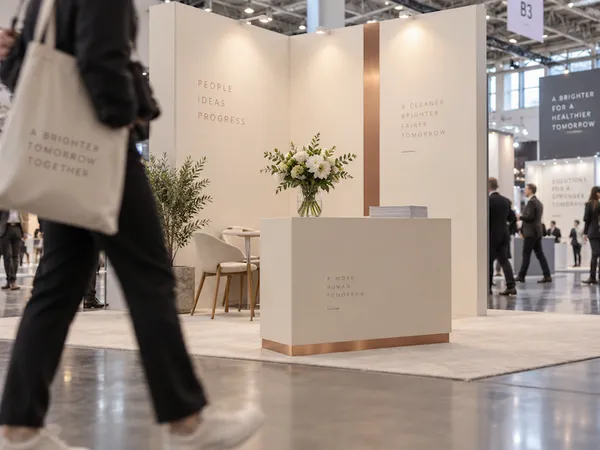
Not at first. They are judging a website on a phone, a quote in an inbox, a van in a car park, a stand at an exhibition. They decide in seconds, they decide before they speak to you, and they are almost never deciding on the thing you are actually good at.

What you actually arethe work, the years, the expertise
What a stranger assumesin about four seconds
This is the part you are losing to people who look more established than you — and you never hear about it, because they simply don't get in touch.
While the gap is open

You compete on price. Customers ask for discounts. Work goes to bigger-looking competitors who are not as good as you, and the quotes you lose are never explained.

Once it is closed

You compete on trust. People assume you are the senior option, booked up, worth waiting for. The conversation starts at "when can you start?" — not "can you match this quote?"

Identity is the cheapest pricing leverage a business will ever buy.

NHS Smoking Matters Project

The End of the Scroll: Escaping the Paragraph

The Challenge

The Smoking Matters team has an incredible success rate, but their brand identity was trapped in paragraphs. Whether on a clinic poster or a staff message board, heavy text asks for effort before it offers value. When it comes to a service people already feel anxious or slightly guilty about, a dense block of clinical copy isn't a conversation starter—it’s a reason to keep scrolling.

The Strategy: A Human-First Identity

While a leaflet can only inform, a human story truly connects. We evolved the service’s communication strategy by championing an authentic, face-to-face brand voice. Working alongside NHS staff, we brought their life-changing work to the screen, creating an engaging, watchable narrative. By stepping beyond standard clinical messaging, we let the people who actually stopped smoking become the welcoming face of the brand—shifting the audience's mindset from "can this be done?" to "who do I call first?"

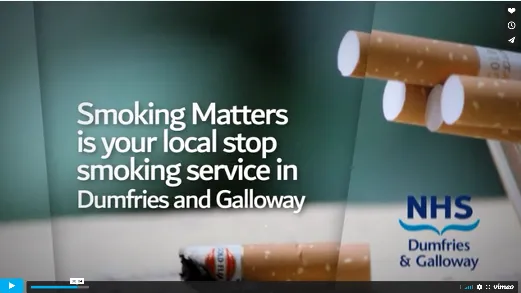
One of the short films made with the Smoking Matters team.

The Deliverables & Impact

  • Relatable Brand Positioning

    Shifted the core identity from clinical explanations to authentic, peer-to-peer visual storytelling.

  • Frictionless Engagement

    Designed thumb-stopping short films engineered for modern social feeds, proving the brand's value before the user scrolls past.

  • Social Proof Over Statistics

    Produced honest, long-form interviews that build brand trust and empathy far more effectively than abstract medical data.

  • Omnichannel Consistency

    Unified the brand’s tone across internal staff boards and public feeds, ensuring a cohesive, recognizable identity at every touchpoint.

  • Evergreen Asset Library

    Built a modular, reusable content library the NHS team can continually deploy, establishing a sustainable long-term brand presence.

Still from an NHS Smoking Matters film reading “Smoking Matters is your local stop smoking service in Dumfries and Galloway”.
Still from an NHS Smoking Matters film reading “Want to stop and improve your health?” over a woman sitting outdoors.
Still from an NHS Smoking Matters film reading “Smoking reduces the amount of oxygen that gets to your skin”.
The same gap, smaller scale

A Covent Garden florist who looked like a relay service.

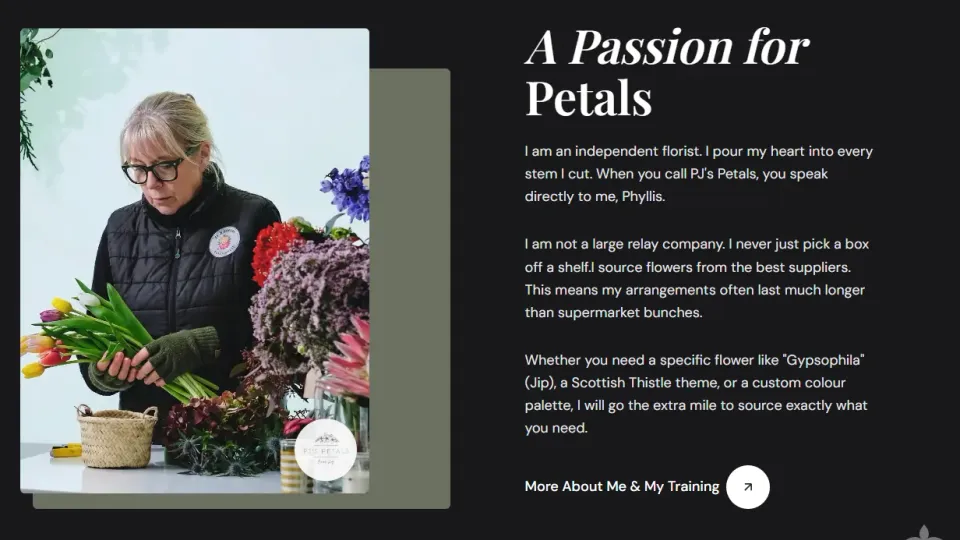
Phyllis Rooney trained at the Covent Garden Academy of Flowers and works from a studio outside Dumfries. Her old website was not ugly — a logo, a soft palette, a moody photograph of roses. It looked perfectly nice, and exactly like every other florist in the country.

Nothing said she trained at Covent Garden. Nothing said that when you ring PJ's Petals, you get Phyllis herself. To a stranger she was hard to tell apart from the national relay services that take an order, take a cut, and pass it to whoever is nearest.

Wedding enquiries went from roughly one a month to one a week — and the enquiries got better. Fewer people ringing round for the cheapest bouquet. More couples who had already decided they wanted her, checking she was free.

Before
PJ's Petals' previous website: a tasteful but generic florist template with a line-drawn logo, stock rose photography and interchangeable copy.

Tasteful, and completely interchangeable. Nothing on the page said who she was or where she trained.

After
PJ's Petals' new brand identity in use: her own logo mark, colour palette, typography and photography of Phyllis working in her studio.

A palette taken from the flowers she actually works with, and photography that puts her hands and her studio in the frame.

Phyllis did not change what she sells, or how she works. She changed what a stranger assumes about her in the first few seconds.

Read the full PJ's Petals story

“Absolutely blown away by my new website! Adam was great from first contact right through the whole process. He totally supported my vision and goals to support my business and the new site is so much better than I could’ve imagined. He clearly cares and he has absolutely delivered for me and my business.”

Phyllis Rooney — Founder, PJ's Petals
Investment

Three levels of
the same discipline.

The design is not better at £20,000. The problem is bigger. One shop in one town has to look right in a handful of places. A group with an acquired brand, teams in several countries and a name that will probably change has to look right in hundreds — and stay that way without you policing it.

All three are fixed price, agreed before we start.

One business, one market

You stop looking like the cheap option.

£3,500Identity · 6–8 weeks

One business, one market, one story. Six to eight weeks of strategy and design, fixed.

Customers stop opening with “what's your best price?”. You get judged on whether you're right for the job — a conversation you win — instead of being lined up against people doing a fraction of your work.

What you get
  • A positioning session — what you're for, who you're for, why you get chosen
  • Logo, plus the variations you'll actually use
  • Colour palette and typography, tested at real sizes
  • Photography direction, so your images stop looking borrowed
  • Plain-English guidelines anyone can follow
  • Every file packaged: social profiles, email signature, document headers
  • The identity applied to your website and main touchpoints
Where it has to workA website, a quote, a shop window, a van, a social profile.
Established, several services

You become easy to explain again.

£12,000Identity and messaging · 8–12 weeks

Twice the surface area — and words that have to work as hard as the look.

Your team can explain the whole business without rehearsing it. The services nobody ever asked about start getting asked about. And your proposals stop looking like they came from three different companies.

What you get
  • A written review of how everyone in your market already looks and sounds
  • A read of your public evidence — reviews, enquiries and the questions you get asked most
  • Positioning and a message hierarchy — what you lead with, what you prove it with
  • Tone of voice with worked examples, not adjectives
  • A full graphic system: layouts, icons, diagrams, the devices that make you recognisable
  • Website design direction and the components to build it from
  • Templates for proposals, presentations, case studies and documents
  • A working session so your own team can use it, and a rollout order
Where it has to workSeveral services, several locations, proposals, presentations and templates your team runs without you.
International and group

You stop being valued as the company you used to be.

£20,000Brand platform · 10–16 weeks

Ten to sixteen weeks of research, architecture, system design and documentation — for a company where being misunderstood costs more than the fee, every quarter. Compressed to eight when a launch date demands it.

Buyers, partners and investors size you correctly at a glance instead of pricing you as the company you were a decade ago. Your regional teams stop inventing their own version of you. And the system holds when you buy the next business, or change your name.

What you get
  • Brand architecture — how the parent, the capability families, the products and the businesses you've bought relate to each other
  • An endorsement strategy so an acquired brand keeps its own equity while gaining yours
  • The written platform: purpose, promise, principles, attributes and personality
  • A full messaging system, corporate boilerplate and a working campaign line
  • A creative direction — one idea, with named visual behaviours the whole system runs on
  • Colour with defined roles, and typography licensed for every market and language you operate in
  • Design tokens and component rules, handed to your web team or agency
  • A phased rollout across regions, channels and physical stock
  • Governance: who owns it, who approves it, what happens when a region wants an exception
  • A name-flexible system, so a future rename replaces one component instead of starting again
  • A recognition test: your unbranded pages set against your competitors' before launch
Where it has to workRegional teams, several languages, partner and distributor material, an acquired brand, datasheets, exhibition stands, and another agency's build.

Not sure which one you're looking at? Request a 30-minute call and we'll tell you honestly — including if the answer is that you don't need this yet, or that a smaller piece of work would do the job.

Request a 30-minute call
No pitch. No pressure.

Ready to close
the gap?

Get in touch and we'll tell you honestly whether your current brand is helping or hurting — and which of the three levels your business actually needs.

Get in touch

Straight answers

Questions we're asked a lot

How is this different from just getting a logo?

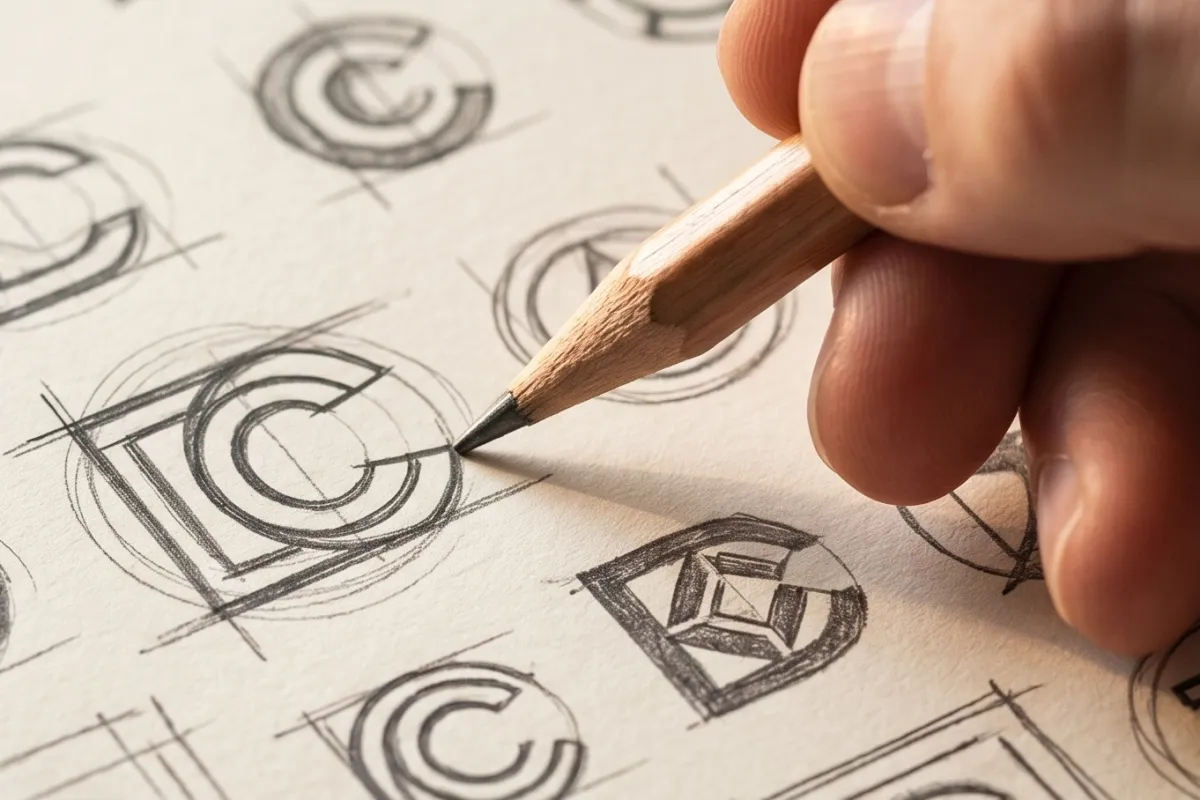
A logo is one decision. A brand identity is the full set — strategy, logo, typography, colour, and how it all applies across your website, van, signage and social media. It's the difference between owning a nice mark and looking like the obvious choice everywhere a customer meets you.

Will you need to talk to our customers?

No. We don't run customer interviews, stakeholder workshops or surveys. The evidence we need is already public — your market, your competitors, your reviews, your own published material and the questions you get asked most — and reading it properly tells us more than a workshop does. You tell us about the business once, and we do the rest.

Why is there such a gap between £3,500 and £20,000?

Because they are genuinely different jobs. At £3,500 we are giving one business in one market a coherent look and the files to use it. At £20,000 we are working out what a company has become, deciding how a parent brand, its capability families, its products and a business it has acquired relate to each other, writing the messages regional teams will use, building a visual system that survives a change of name, handing design tokens to a web team, and setting out who owns and approves it afterwards. The design is not ten times better. The problem is ten times larger.

What actually changes at the £20,000 level?

Four things, mostly. Research: we review your market, your competitors and your own public evidence before we design anything. Architecture: how your parent brand, sub-brands, products and any acquisitions relate. Documentation: design tokens, component rules and templates detailed enough for other teams and agencies to build from without ringing us. And governance: named owners, named approvers, a rollout order, and rules for what happens when a region wants an exception.

We're not in the UK. Does that work?

Yes — the £20,000 level is built for it. Multiple regions, multiple languages, partner and distributor materials, and typography licensed for global desktop, web, app and document use. Most of the work happens in scheduled video sessions and a shared document, and we've run programmes to a fixed launch date across several time zones. We write in British English unless you need otherwise.

Can you work alongside our existing web agency?

Regularly, yes. At the £12,000 and £20,000 levels part of the work is a handover package built for exactly that: colour and typography tokens, spacing and grid rules, button, card and status behaviour, image treatments, motion examples, and desktop and mobile reference screens. Your agency builds it. We make sure what they build is recognisably you.

We're changing our company name. Should we wait?

No — but tell us, because it changes how we build. A system that only works because of your current initials has to be redone when the name changes. A name-flexible system treats the wordmark as one replaceable component, and keeps recognition in colour, type, imagery, layout and motion. You get the benefit now and change one piece later, instead of paying for two rebrands.

Do I need the brand identity before the website?

Ideally, yes — the identity decides how the website looks, not the other way round. But real businesses don't always work in the ideal order, and we regularly do both together. What we'd steer you away from is a new website in an old identity you already know you've outgrown.

We're a small business — is this overkill?

Honest answer: sometimes. If your work sells itself and your current look isn't costing you customers, we'll tell you to keep your money. Where it earns its keep is when you're competing for premium work and turning up looking like the budget option. That is what the £3,500 level is for.